

Severe storms can damage trees in a matter of minutes. High winds, heavy rain, hail, snow, and ice can break large branches, split trunks, uproot trees, and leave trees leaning toward homes, cabins, driveways, and other structures.
After a major Minnesota storm, the most important thing is to stay clear of damaged trees and inspect the property from a safe distance before beginning cleanup. A tree or branch that survived the storm may still be unstable and can shift or fall later.
Knowing what to look for can help you decide whether the damage is minor, whether pruning may be enough, or whether professional tree removal is needed.
Before walking around your property, look for hazards that may require immediate attention.
Watch for:
• Fallen trees on homes, cabins, garages, or vehicles
• Trees blocking driveways or access roads
• Trees or branches near utility lines
• Large hanging branches
• Split trunks
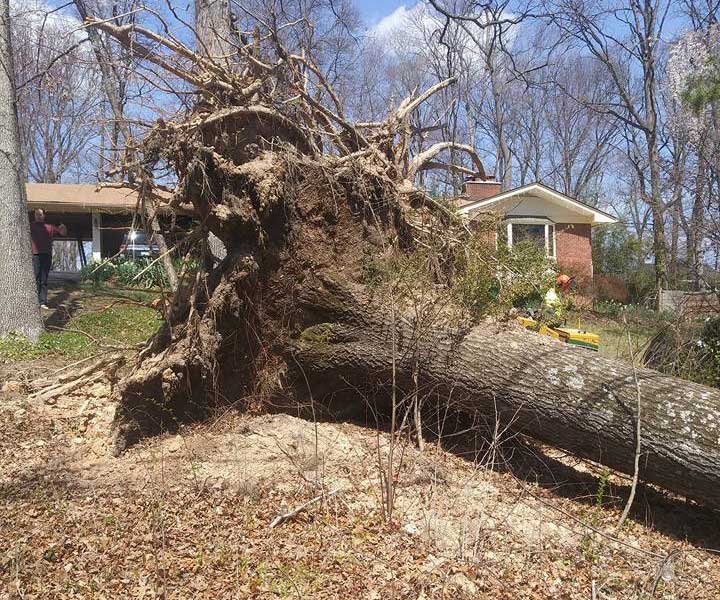
• Partially uprooted trees
• Trees that have suddenly started leaning
• Large limbs resting on roofs or other structures
If a tree or large branch is threatening people, buildings, or access to your property, professional emergency tree service may be necessary.
Do not approach a tree that is touching or close to a downed power line. Treat all downed utility lines as energized and contact the appropriate utility provider or emergency service.
One of the most dangerous conditions after a storm is a large branch that has broken but remains suspended in the tree.
These branches may be difficult to see from the ground and can fall without warning.
Storm-damaged branches may be:
• Partially attached to the trunk
• Resting on other branches
• Caught in neighboring trees
• Twisted or under tension
• Hanging above driveways, decks, sidewalks, or yards
Do not stand underneath damaged limbs or try to pull them down with ropes, vehicles, ladders, or other equipment.
Large hanging branches often require professional equipment and carefully planned cuts to remove them safely.
A tree that begins leaning after a storm deserves close attention.
Not every leaning tree is dangerous. Some trees naturally grow at an angle and remain stable for decades. The bigger concern is a tree that was previously upright and has recently changed position.
Look around the base of the tree for:
• Lifting or heaving soil
• Newly exposed roots
• Broken roots
• Cracks in the soil
• Movement around the root plate
• A noticeably increasing lean
These signs can indicate that part of the root system has shifted or failed.
If you are unsure whether the lean is serious, read our guide on how to tell if a leaning tree may be dangerous.
Storm damage can create structural problems that are not always obvious from a distance.
Look for:
• Cracks running through the trunk
• Splits where major stems meet
• Broken tops
• Partially detached branches
• Large sections of exposed wood
• Fresh wounds
• Separation between multiple trunks
A small broken branch may simply need pruning. A large trunk split or major structural crack can be much more serious, particularly when the tree is near a home or cabin.
Avoid climbing the tree or inspecting cracks from underneath damaged limbs. A visual inspection from the ground is the safest first step.
Storm damage does not automatically mean a tree needs to be removed.
Some trees can recover well after damaged branches are properly pruned. Others may be too structurally compromised to remain safely.
A tree may be more likely to recover when:
• Most of the trunk remains intact
• The root system appears stable
• Damage is limited to smaller branches
• The canopy still has a substantial amount of healthy growth
• Major structural limbs are intact
Professional tree pruning may be able to remove broken or damaged branches while preserving an otherwise healthy tree.
Removal becomes more likely when the tree has:
• Major root failure
• Severe trunk splitting
• Extensive structural damage
• A large portion of the canopy destroyed
• Significant decay combined with storm damage
• A sudden lean caused by root movement
• Damage that creates an unacceptable risk to people or property
When a tree cannot safely be preserved, professional tree removal may be the safest option.
Trees that fall onto buildings require extra caution.
A large tree resting on a roof, cabin, garage, deck, or vehicle may appear stable, but its weight can be distributed across several points. Cutting one branch or trunk section can cause the remaining tree to shift unexpectedly.
That can result in additional property damage or create a serious hazard for anyone nearby.
This is especially important throughout the Brainerd Lakes Area, where large mature trees often grow close to homes, seasonal cabins, garages, shorelines, and narrow driveways.
Lake properties can also present difficult access, slopes, landscaping obstacles, and limited room for equipment.
Nic's Works specializes in large and hazardous tree removal, including difficult trees located close to homes and cabins.
If a storm has caused property damage, document the condition before cleanup begins when you can do so safely.
Photograph:
• Fallen trees
• Damaged roofs or siding
• Broken branches
• Trees resting on structures
• Damaged vehicles
• Uprooted trees
• Debris around the property
Homeowners insurance policies vary, so contact your insurance provider to ask what documentation they may require before debris or damaged trees are removed.
Do not delay necessary emergency work if a tree presents an immediate safety hazard, but take photographs first when it can be done safely.
Not every branch on the ground requires a tree service company.
Small branches lying flat on the lawn can often be handled as ordinary yard cleanup.
Professional assistance becomes more important when the damage involves:
• Large branches
• Hanging limbs
• Trees under tension
• Split trunks
• Partially uprooted trees
• Trees leaning toward structures
• Trees resting on houses or cabins
• Large storm-damaged trees requiring chainsaws or climbing
• Work close to utility lines
A good rule is to avoid cutting anything that could move, roll, swing, fall, or change position once weight is removed.
Professional storm cleanup usually begins with an assessment of the damaged trees and the surrounding property.
The crew may determine:
• Which hazards need to be addressed first
• Whether damaged trees can be pruned or need removal
• How equipment can safely access the property
• How tree sections can be removed without causing additional damage
• What debris needs to be hauled away
• Whether stump grinding should be completed afterward
Nic's Works provides storm damage cleanup for fallen trees, broken branches, damaged trees, and storm debris throughout the Brainerd Lakes Area.
For trees that need complete removal, the crew can safely dismantle the tree in sections when there is not enough room to drop it in one piece.
After the obvious storm damage is removed, take another look at the trees that are still standing.
A tree may have survived the storm but still have:
• Broken branches high in the canopy
• Fresh cracks
• Damaged roots
• A new lean
• Split branch unions
• Large wounds
• Canopy damage
Some of these problems may be addressed through pruning. Others may need monitoring or removal depending on the severity of the damage.
This is one reason a post-storm property inspection can be worthwhile even when no entire tree has fallen.
Does a storm-damaged tree always need to be removed?
No. Some trees can be preserved through proper pruning if the trunk, root system, and major structural branches remain sound. Trees with severe root failure, major trunk splits, or extensive structural damage may need removal.
Can a split tree be saved?
Sometimes. It depends on the location and severity of the split, the size of the tree, and the condition of the remaining structure. Large trunk splits should be evaluated carefully.
What should I do if a tree falls on my house?
Stay out of the affected area and avoid attempting to cut or move the tree yourself. Contact the appropriate emergency services if there is an immediate danger, and arrange for professional tree removal when it is safe to do so.
Is a leaning tree dangerous after a storm?
A newly leaning tree is more concerning than a tree that has grown at an angle for many years. Look for lifting soil, broken roots, exposed roots, cracks, and other signs of root movement.
Should I cut down a hanging branch myself?
Large hanging branches can be unpredictable and may fall or swing when cut. Professional removal is usually the safer option when a branch is large, high in the tree, or positioned over people or property.
Does homeowners insurance cover storm-damaged tree removal?
Coverage varies by policy and circumstances. Contact your insurance provider directly to determine what may be covered and what documentation is required.
Storms can create very different types of tree damage, from a few broken branches to large trees falling onto homes and cabins.
Nic's Works provides professional tree services throughout Brainerd, Baxter, Nisswa, Crosslake, Pequot Lakes, Merrifield, Breezy Point, East Gull Lake, Lake Shore, and surrounding Central Minnesota communities.
Our crews handle:
• Storm-damaged tree removal
• Large and hazardous trees
• Trees near homes and cabins
• Broken and hanging branches
• Difficult-access tree removal
• Tree pruning
• Tree removal
• Storm debris cleanup
• Stump grinding
If your property has been damaged by a storm, request an estimate from Nic's Works for professional storm cleanup and tree service.
Nic's Works LLC
954 Poplar Drive
East Gull Lake, MN 56401
218-270-0861
